When you are in a truck accident, your first thought is safety and getting help. The reality is, proof of what happened starts to disappear soon after.
Heavy vehicle accidents involve trucks and buses rated above 4.5 tonnes. Our team at vbr Lawyers is familiar with these accident claims under Queensland law, so we can share some lessons.
Here, we will be discussing mainly four topics for injured people:
- Evidence that disappears after a crash
- Records worth keeping from day one
- The claim types that may apply
- Proof of lost income and home help
Let us start with why that proof disappears so quickly.
Truck Accident Lawyer Lessons: Why Proof Disappears
Proof disappears because operators overwrite data, repair vehicles and archive records during routine business. The truth is, nobody needs to destroy anything on purpose after a motor vehicle accident.
In heavy vehicle accidents, the records that show how the accident happened sit with the operator, not with you. Some of those records come from telematics, which are onboard devices that log a truck’s braking, speed, location, and driving hours.
Once the vehicles involved return to service, the physical proof goes with them. Your photos and notes are the one record you control. So whatever survives the first few weeks is what your claim can rely on down the track.
Which Evidence Is at Risk in an Accident Claim?
Four records tend to go missing after heavy vehicle accidents: telematics data, fatigue diaries and work records, trailer damage and witnesses. Different parties hold each one, so no single request secures them all.
Telematics Data: Overwritten Within Weeks
The operator, which is the company that runs the truck, stores telematics data. Some systems overwrite it on a rolling cycle, and retention varies by device and provider.
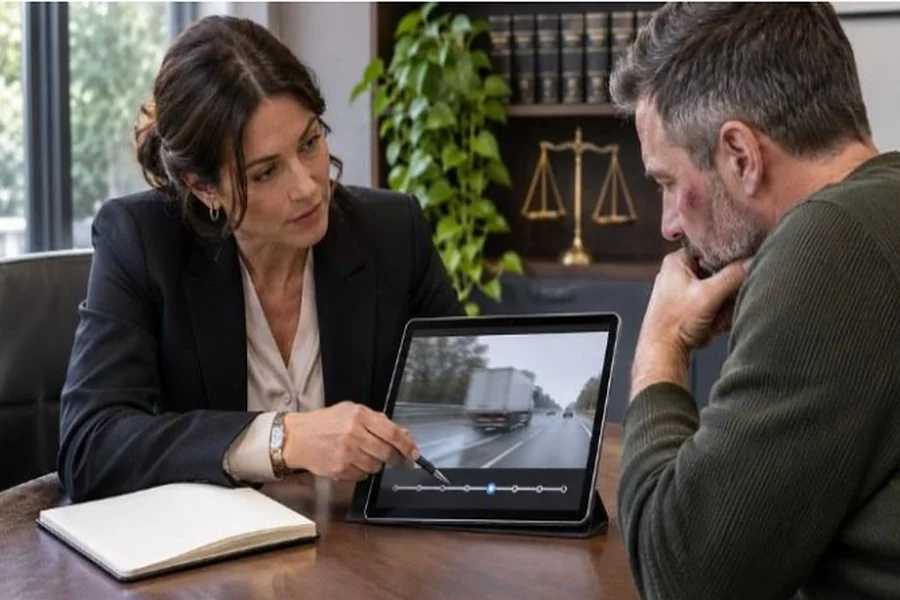
Telematics logs what a motor vehicle did before impact. That covers speed, braking, location and hours driven. Lawyers want this data early when gathering evidence on how the accident happened.
So what does that mean in practice? After a motor accident, a written request asking the operator to keep the data creates a dated record of your request. It cannot force the operator to comply (retention periods differ, so ask rather than assume.)
Address the request to the operator’s safety or compliance manager by name if possible, or to the registered business address. State the date, time, and location of the accident, and ask the operator to preserve all telematics data, driver records, and maintenance logs for the vehicles involved.
And send it by email with a read receipt, or by registered post, so you have proof it was delivered and when.
Fatigue Diaries and Work Records
Picture a long haul driver heading north on the Bruce Highway. Weeks later, the operator archives the driver’s work diary on its normal cycle, before anyone has asked for it.
A work diary records driving hours, rest breaks and shift times. Heavy vehicle law requires some drivers to keep one. In heavy vehicle accidents, work diaries and the operator’s driver records can show if fatigue played a part.
If you were the other driver, you will not see these records unless someone requests them in writing. Physical injuries and treatment can leave little time for paperwork. A missing entry is hard to rebuild.
Trailers Repaired Before the CTP Insurer Inspects
Photos taken early give you a record that survives repairs. Think about it this way: once a trailer returns to service, nobody can inspect the original damage.
CTP insurance, short for Compulsory Third Party, is Queensland’s mandatory cover for injury caused by a registered vehicle. The at-fault vehicle’s CTP insurer handles the claim. That means its inspection timing can decide how much damage is still there to see.
CTP insurers may take several weeks to arrange an inspection, by which time the operator may have already repaired the vehicle. If you have notified the insurer and the vehicle is still damaged, ask whether an early inspection is possible. Your own photographs from the scene become the primary record if the vehicle is repaired before the insurer sees it.
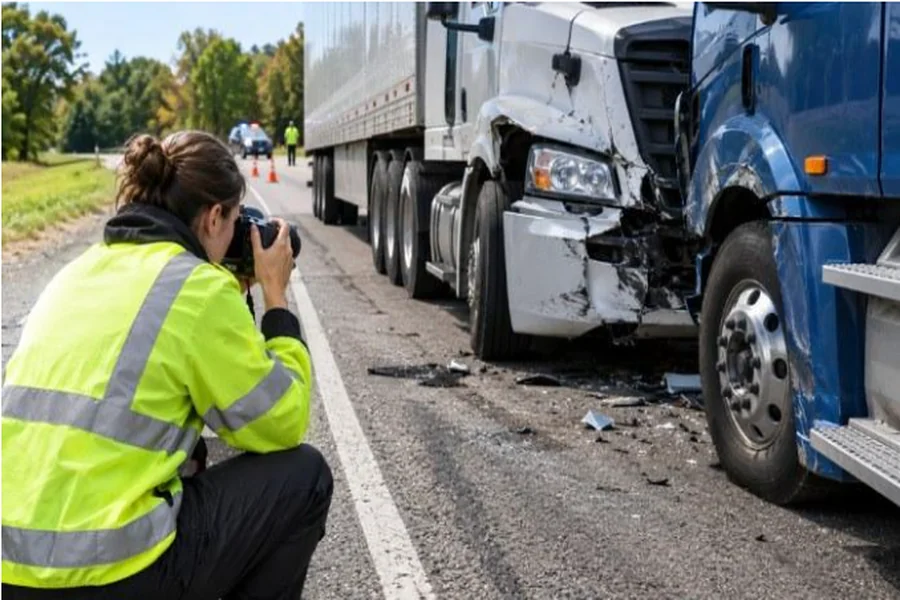
After a motor vehicle accident, photograph the scene, the load and each damaged panel from all angles you can reach. Keep repair estimates too, because they show the damage before the work began. A phone camera is enough.
Witnesses Who Move On
A name and phone number noted on day one gives you someone who can confirm what happened. Say a crash blocks the Gateway Motorway at peak hour, and passing road users drive on without leaving details.
Witnesses can change numbers or leave the area soon after a car accident or truck crash. So, record each person’s name and number straight away (sounds like a lot to ask after a crash, we know). Witness statements are easier to take while memories are fresh.
Worth noting: dashcam and shopfront footage can overwrite on short cycles, so ask nearby businesses for copies. In a hit-and-run, that footage may be the only lead.
Car Accident Claim vs CTP Claim in a Truck Crash
A car accident claim involving a truck usually runs as a CTP claim, and each record sits with a different holder.
| Evidence type | Who holds it | Usual risk |
| Telematics data | Truck operator | Overwritten on a cycle |
| Work diaries | Operator | Archived routinely |
| Trailer damage | Operator, CTP insurer | Repaired before inspection |
| Witness details | Other road users | Contact lost |
Queensland legislation sets up a fault-based scheme. That is why these records help show who was responsible. The at-fault vehicle’s CTP insurer, the insurance company behind its registration, handles the CTP claim.
In legal terms, that is a common law claim, which seeks damages for losses caused by negligence. A driver hurt at work may have a workers’ compensation claim too, called WorkCover in Queensland.
Act Early: Records for Domestic Assistance and Earning Capacity
Ever wondered which records help you claim compensation for lost income or help at home? Three are worth keeping an eye on (not an exciting task, admittedly):
- Pay and Work Records: Payslips from the six months before the accident show your lost income. Future earning capacity means your ability to earn income later, and it can drop even after you return to work. Besides payslips, tax returns and missed shift notes show that change.
- Medical Records and Receipts: Request your medical records after each visit. When medical treatment continues, keep receipts for physio and other rehabilitation expenses. Then label each receipt with the date and reason, since a bare receipt says little about your medical expenses.
- Home Help Notes: Domestic assistance means unpaid help with housework, cooking or care. Although family members often step in unasked, that care can still form part of a claim. However, a log of who helped and for how long is easier to rely on than memory.
Record each day’s help in a simple diary or spreadsheet: the date, who helped, the hours they spent, and the tasks they did (cooking, cleaning, driving to appointments, childcare). Continue logging until your lawyer advises you to stop, as the period of domestic assistance can extend well beyond the initial recovery.
Compensation Lawyers and Your Common Law Claim: A Clear Next Step
Under Queensland law, the accident claim form generally needs to be lodged within nine months of the crash, or one month after first receiving legal advice, whichever is earlier. Court proceedings generally must start within three years. These timeframes have exceptions, so check with a lawyer about the deadlines that apply to your situation.
Compensation lawyers can explain how a common law damages claim runs. Contact our Brisbane office for information about heavy vehicle claims, or read our truck accident lawyer page.